

You have likely stumbled upon a listing for Z (Z), described as a Web3 coin built on the Solana blockchain. It sounds promising: high speed, low fees, and a futuristic ticker. But here is the hard truth that most aggregator sites won't tell you upfront. As of May 2026, there is no verifiable, live cryptocurrency project simply called "Z" with the ticker "Z" operating on Solana.
If you are looking to buy this coin, invest in it, or use it in a decentralized application, you need to stop right now. What you are seeing is not a mature financial asset. It is a placeholder-a digital ghost entry created by data aggregators like CoinSwitch to fill out their Solana listings. There is no team, no whitepaper, no contract address, and certainly no liquidity pool where you can trade it safely.
The Reality Behind the Listing
Let’s look at the only place this token appears to exist: the Indian crypto exchange and aggregator, CoinSwitch. On their platform, you will find a page titled "(Z) on Solana." The description claims it is a "Web3 coin built on the fast and scalable Solana blockchain." That sentence is technically true because every token on Solana inherits those network features. It is generic marketing fluff.
When you dig deeper into that specific CoinSwitch page, the numbers vanish. The market cap is blank. The trading volume is zero. The circulating supply is listed as "-". Even worse, the FAQ section on that very page admits that "the coin's data will be updated in the future." This is the smoking gun. A real project does not ask users to wait for its own existence to be confirmed. It launches, lists its contract address, and starts trading.
Why does this page exist? Exchanges and aggregators often create template pages for requested tokens before they actually go live. They use internal slugs-long, random strings of characters in the URL-to keep their database organized. In this case, Z (Z) is just an empty shell waiting for a project that has never materialized.
Technical Verification: Why It Doesn't Exist Yet
To understand why Z (Z) is currently non-functional, we need to look at how tokens work on Solana. Unlike Bitcoin or Ethereum, where tokens might have different standards, Solana uses the SPL standard (Solana Program Library). Every valid SPL token has a unique mint address-a long string of alphanumeric characters that acts as its ID card on the blockchain.
If Z (Z) were a real, active token, you would be able to find its mint address on major block explorers like Solscan, SolanaFM, or the official Solana Explorer. You could also find it in the Solana Token Registry on GitHub, which maintains a list of verified tokens for wallets to display correctly.
I ran extensive searches across these platforms. Here is what I found:
- No Mint Address: There is no canonical token named "Z" with ticker "Z" registered on Solana mainnet-beta.
- No Liquidity Pools: Major decentralized exchanges (DEXs) like Raydium, Orca, and the aggregator Jupiter do not have any trading pairs for Z/SOL, Z/USDC, or Z/USDT.
- No Wallet Support: Popular Solana wallets like Phantom and Solflare do not auto-detect a token called "Z". Without a verified registry entry, your wallet wouldn't even know what icon to show for it.
Without a contract address, you cannot send, receive, or store this token. Any claim that you can already transact with Z (Z) is false.
Don't Confuse It With Real "Z" Coins
This is where things get dangerous for new investors. Because "Z" is such a common letter, many people mistake this placeholder Solana entry for established cryptocurrencies that actually have value, history, and utility. Do not mix them up.
| Feature | Z (Z) on Solana | Zcash (ZEC) | ZigZag (ZZ) | Firo (FIRO) |
|---|---|---|---|---|
| Status | Placeholder / Non-existent | Active Privacy Coin | Active DEX Token | Active Privacy Chain |
| Blockchain | Solana (Theoretical) | Own L1 (PoW) | Ethereum / zkSync | Own L1 |
| Ticker | Z | ZEC | ZZ | FIRO (formerly XZC) |
| Launch Date | N/A | October 2016 | 2021 | September 2016 |
| Primary Use Case | None | Private Transactions | Decentralized Trading | Privacy & Security |
| Market Data | Zero / Blank | Listed on Binance, Coinbase | Listed on Crypto.com | Listed on Kraken, Binance |
Zcash (ZEC) is a privacy-focused cryptocurrency launched in 2016 by the Electric Coin Company. It uses advanced cryptography called zk-SNARKs to hide transaction details. It has a massive market cap and is traded on all major exchanges. It is absolutely not the same as the Solana Z token.
ZigZag (ZZ) is a token associated with a decentralized exchange originally built on zkSync and later expanded to other chains. It has a real circulating supply and price history, but it operates primarily on Ethereum-compatible networks, not Solana.
Firo (FIRO), formerly known as Zcoin, is another privacy coin that rebranded in 2020 to distance itself from regulatory scrutiny. It runs on its own blockchain and has nothing to do with Solana or the Z (Z) placeholder.
Red Flags and Risks You Must Know
Even if a project behind Z (Z) eventually launches, the current lack of information presents severe risks. In the world of crypto, anonymity is often a warning sign. Here is why you should treat this token with extreme caution:
- No Team Identity: Legitimate projects disclose their founders, developers, and company structure. This allows investors to verify expertise and hold the team accountable. Z (Z) has no names attached to it. If the code contains a backdoor, who do you sue?
- No Tokenomics: We don't know the total supply. Is there 1 million coins or 1 trillion? Without knowing the allocation (how much goes to the team, investors, or public), you cannot assess inflation risk. A hidden large supply held by the creators can lead to a "rug pull," where they dump their holdings and crash the price.
- No Smart Contract Audit: Since there is no contract address, there has been no security audit. Firms like Trail of Bits or ChainSecurity review code for vulnerabilities. An unaudited token is a gambling chip, not an investment.
- Regulatory Grey Area: Regulatory bodies like the U.S. SEC and Europe's ESMA warn against investing in assets without clear documentation. A token with no whitepaper fails basic due diligence.
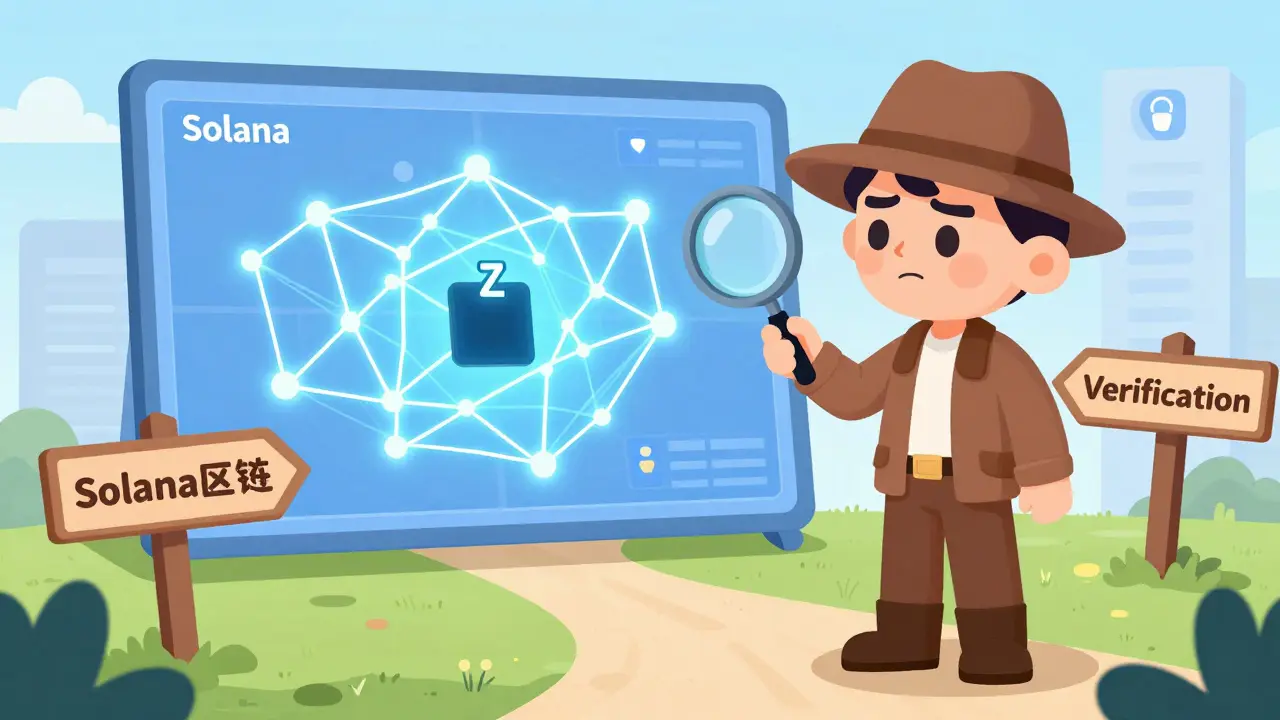
How to Verify Any New Crypto Token
Use the mystery of Z (Z) as a learning moment. Before you ever put money into a new coin, follow this checklist to ensure it is real:
- Find the Contract Address: Ask for the mint address. Copy it into a block explorer (like Solscan for Solana or Etherscan for Ethereum). If the address shows zero transactions and no balance, the token is dead or fake.
- Check Multiple Aggregators: Look for the token on CoinMarketCap and CoinGecko. These platforms have strict verification processes. If a token is only on one obscure site, it is likely a scam or a placeholder.
- Read the Whitepaper: A legitimate project explains what problem it solves, how the technology works, and who the team is. If there is no website or document, walk away.
- Verify Community Presence: Search Twitter/X, Reddit, and Discord. Real projects have active communities discussing development updates. If you search "$Z Solana" and find nothing but silence, the project does not exist.
- Look for Liquidity: Check if the token is traded on reputable DEXs or CEXs. If you can't buy it anywhere except a shady Telegram link, it is a trap.
Conclusion: Wait for Proof
The "Z (Z) crypto coin" on Solana is currently a myth wrapped in a database entry. It is a placeholder that serves no function for traders, developers, or users. While CoinSwitch may update its page in the future if a real project emerges, today, it is effectively non-existent.
Do not confuse it with Zcash, ZigZag, or Firo. Those are real assets with real histories. Z (Z) has none of that. In the volatile world of cryptocurrency, patience and verification are your best defenses. Until you see a verified contract address, a transparent team, and live trading volumes on major platforms, keep your wallet closed. There is no rush to buy something that doesn't exist yet.
Is Z (Z) coin available for trading on Binance or Coinbase?
No. As of May 2026, neither Binance nor Coinbase lists a token called Z (Z) on the Solana blockchain. Searches on these major centralized exchanges yield no results for this specific ticker. Be wary of any third-party site claiming otherwise, as they may be phishing scams.
What is the difference between Z (Z) and Zcash (ZEC)?
They are completely unrelated. Zcash (ZEC) is a well-established privacy cryptocurrency launched in 2016 with its own blockchain and proof-of-work consensus. Z (Z) is a placeholder listing on Solana with no live token, no team, and no functionality. Never use them interchangeably.
Why does CoinSwitch list a token that doesn't seem to exist?
Exchanges and aggregators often create template pages for requested or anticipated tokens to maintain their database structure. These pages serve as placeholders until a project provides official contract addresses and listing details. The presence of a page does not guarantee the token is live or tradeable.
Can I store Z (Z) tokens in Phantom or Solflare wallets?
Technically, you can add any custom SPL token to wallets like Phantom or Solflare if you have the correct mint address. However, since Z (Z) has no verified contract address, adding it manually would result in a token with zero value and no ability to be transferred or sold. It is not recommended.
Is Z (Z) coin a scam?
It is not necessarily a scam in the sense of a malicious attack, but it is highly speculative and potentially misleading. It lacks all the hallmarks of a legitimate project: no team, no whitepaper, and no liquidity. Treating it as a real investment carries extreme risk of loss, especially if scammers create fake tokens with similar names to trick users.