


The WSPP airdrop wasn’t just another crypto giveaway. It was a promise - that blockchain could help the poor. Launched in late 2021, Wolf Safe Poor People (WSPP) claimed to be the first cryptocurrency designed to reduce global poverty. Its airdrop on Polygon wasn’t just about handing out free tokens. It was meant to fund real-world aid through decentralized tech. But what actually happened after the hype? And who got anything out of it?
How the WSPP Airdrop Actually Worked
The main WSPP airdrop didn’t happen on a decentralized exchange or through a smart contract claim. It was tied to MEXC’s Kickstarter program. Users had to stake MX tokens - MEXC’s native token - to vote for WSPP to be listed on their exchange. The goal? Reach 18,956,491.25 MX tokens in votes. When that number was hit on December 13, 2021, the listing went live… and so did the airdrop. Participants who staked MX got 215,000,000 WSPP tokens split between them. That’s about 0.06 WSPP per MX token staked. No sign-up forms. No KYC. Just staking and waiting. It was simple, fast, and gave real value to MEXC’s active users. The project didn’t need to raise funds - it used community voting as the trigger. The WSPP token on Polygon launched with contract address0x46d502fac9aea7c5bc7b13c8ec9d02378c33d36f. This version was chosen because Polygon offered cheaper, faster transactions than Binance Smart Chain - where the original WSPP token lived. The move made sense for a project that wanted low-cost micro-transactions to support aid programs.
What WSPP Claimed It Would Do
Wolf Safe Poor People didn’t just say it was a token. It said it was a movement. The website claimed WSPP was “the first currency that has a program to reduce world poverty.” The idea? Every time someone held or traded WSPP, a small percentage of each transaction would be automatically redirected to fund poverty relief. No middlemen. No overhead. Just code. They called it an “automatic imbalance” - a redistribution mechanism that rewarded holders while funding social causes. The backend was supposed to run on decentralized storage like Swarm, making it resistant to shutdowns. The project also planned to build Wolfible, a platform for NFT-based fundraising tied to real poverty projects. It sounded like science fiction. But it was built on real tech: smart contracts, tokenomics, and blockchain transparency. The problem? No one could prove it worked.Who Got the Airdrop - And What They Did With It
Around 5,000-7,000 users participated in the MEXC Kickstarter. Most were experienced crypto traders. They weren’t poor people in Kenya or India. They were people who already understood staking, exchanges, and tokenomics. The airdrop didn’t reach the intended beneficiaries. It reached the crypto-savvy. After claiming their tokens, many sold immediately. Why? Because WSPP had no real utility. No app. No working platform. No charity partnerships. Just a website with bold claims and a token that couldn’t be spent on anything. The original BSC version of WSPP traded at $6.24e-11 USD - less than one ten-billionth of a cent. The Polygon version? Around $1.94e-8 USD. That’s still less than one one-hundred-millionth of a dollar. At that price, you’d need over 50 billion tokens to make $1. The market cap? Around $54 on Polygon. That’s less than the cost of a coffee in Wellington.
Why the Project Never Took Off
WSPP had three big problems:- No real impact tracking. There was no public ledger showing how much money went to poverty programs. No receipts. No partners. No reports.
- No usable product. Wolfible never launched. The DApp platform was never built. The website was a single page with a whitepaper and a Telegram link.
- No liquidity. Trading volume was near zero. You couldn’t buy WSPP on Binance, Coinbase, or Kraken. Only MEXC and a few small DEXs. Even there, bids were sparse.
Where WSPP Stands Today (December 2025)
As of late 2025, WSPP still exists - technically. The Polygon contract is live. The token is still tradable on MEXC. But no one’s buying. No one’s selling. The Telegram group @robowolfproject has about 1,200 members. Most posts are from bots or someone asking, “Is this dead?” The original team vanished. No updates. No roadmap changes. No new features. The website still says “Helping the poor since 2021,” but there’s no evidence of any donations, projects, or outcomes. The airdrop was real. The tokens were real. The impact? Not real at all.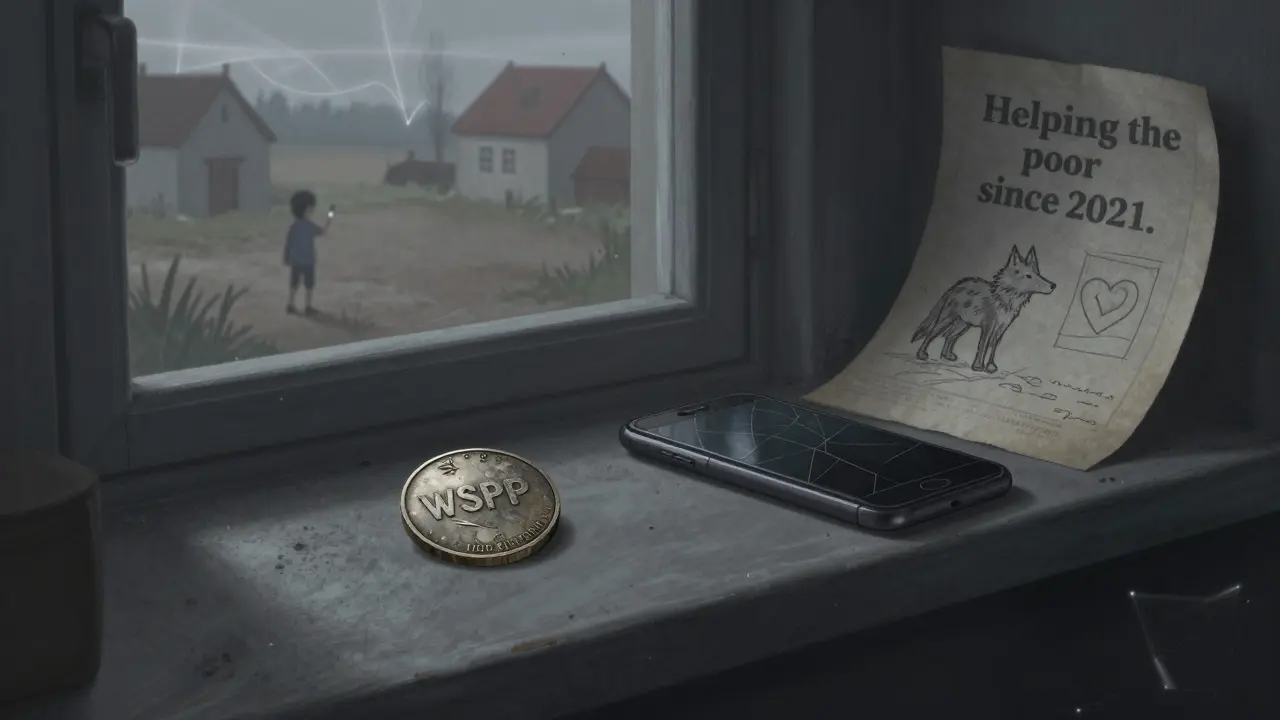
What You Can Learn From WSPP
This isn’t a story about a scam. It’s a story about empty promises wrapped in good intentions. Many crypto projects claim to “do good.” But doing good requires transparency, accountability, and execution. WSPP had none of that. It had a nice logo, a noble mission, and a secure contract. But without measurable outcomes, it was just noise. If you’re considering any airdrop tied to a social cause:- Check if the project has publicly verified partnerships with NGOs or aid organizations.
- Look for on-chain donation tracking - not just promises.
- See if the team has real-world experience in poverty relief - not just crypto.
- Ask: Can I actually use this token for anything? Or is it just a speculative asset?
Is There Any Way to Claim WSPP Tokens Today?
No. The airdrop window closed in December 2021. There’s no ongoing claim portal. No future airdrops. The tokens you got back then are still sitting in your wallet - if you claimed them. If you didn’t participate, you can’t get them now. The supply is fixed. No more will be minted. The only way to get WSPP today is to buy it on MEXC or a small DEX - but with a market cap under $60, it’s more of a curiosity than an investment.What Comes After WSPP?
The idea behind WSPP - using crypto to fight poverty - isn’t dead. It just needs better execution. Projects like GiveCrypto and UNICEF CryptoFund have proven it’s possible. They send actual crypto to people in need, track it on-chain, and report outcomes. No vague promises. Just results. WSPP’s legacy? A cautionary tale. You can’t solve poverty with a token alone. You need real partnerships, real transparency, and real action. The blockchain can help. But it can’t replace human effort. If you’re looking for crypto that does good, don’t chase airdrops. Look for projects that show you exactly where the money went.Was the WSPP airdrop real?
Yes, the WSPP airdrop was real. It happened in December 2021 through MEXC’s Kickstarter program. Users who staked MX tokens received 215,000,000 WSPP tokens in total, distributed proportionally based on participation. The tokens were delivered to wallets automatically after the voting goal was met.
Can I still claim WSPP tokens from the airdrop?
No, the airdrop claim period ended in December 2021. There is no official portal or smart contract open for claiming new WSPP tokens. The only way to obtain WSPP today is to buy it on exchanges like MEXC, but liquidity is extremely low and the token has minimal market value.
Is WSPP still active in 2025?
Technically, yes - the smart contract on Polygon is still live and the token can be traded on MEXC. But the project has been inactive since 2022. The team stopped posting updates, the Wolfible platform was never built, and there’s no evidence of any poverty relief efforts funded by the token. It’s effectively dormant.
Why did WSPP fail?
WSPP failed because it had no real-world impact. The project promised to reduce poverty using blockchain, but never partnered with any aid organizations, never tracked donations publicly, and never launched the tools it promised. The airdrop attracted crypto traders, not the poor. Without execution, even the best intentions collapse.
Was the WSPP smart contract safe?
Yes. The WSPP smart contract was audited by Solidity Finance, a reputable blockchain security firm. The audit found no critical vulnerabilities, backdoors, or rug-pull mechanisms. The code was secure - but security doesn’t equal usefulness. The project’s failure was in design, not code.
What’s the current price of WSPP on Polygon?
As of December 2025, the WSPP token on Polygon trades at approximately $0.0000000194 (1.94e-8 USD). With a total supply of 3.2 billion tokens, the market cap is around $54 USD. Trading volume is near zero, indicating almost no active buying or selling.
Can I use WSPP to send money to poor communities?
No. There is no mechanism in place to send WSPP to poverty-stricken areas, and no verified recipients or distribution channels exist. The token has no utility beyond speculative trading on a few low-volume exchanges. It cannot be used to fund aid, buy goods, or support any social program.
Did WSPP ever donate to any charities?
There is no public record of any donations made by WSPP to charities, NGOs, or poverty relief programs. The project claimed to automatically redistribute funds to help the poor, but no on-chain transactions, reports, or partner announcements have ever been published to verify this.
Vernon Hughes
December 30, 2025 AT 05:58People think blockchain can magically fix poverty. It can't. It's a tool. Not a savior.
Alison Hall
January 1, 2026 AT 03:43Brooklyn Servin
January 2, 2026 AT 10:13Phil McGinnis
January 3, 2026 AT 22:09Ian Koerich Maciel
January 5, 2026 AT 10:28Andy Reynolds
January 6, 2026 AT 09:22Daniel Verreault
January 8, 2026 AT 05:39Jacky Baltes
January 8, 2026 AT 18:18Abhisekh Chakraborty
January 10, 2026 AT 10:43dina amanda
January 11, 2026 AT 05:03Kevin Gilchrist
January 11, 2026 AT 12:02NIKHIL CHHOKAR
January 12, 2026 AT 10:38Mike Pontillo
January 14, 2026 AT 06:36Joydeep Malati Das
January 15, 2026 AT 14:29rachael deal
January 16, 2026 AT 10:26Elisabeth Rigo Andrews
January 17, 2026 AT 04:47Mandy McDonald Hodge
January 19, 2026 AT 01:16