

Who actually runs the platform you trust with your savings? Most of us look at fees, speed, or app design. But the real story behind a crypto exchange is the leadership steering it through legal storms and market crashes. In 2025, the industry shifted from wild west chaos to a structured, regulated environment. This change didn't happen by accident. It was driven by specific CEOs making high-stakes decisions that directly impact your ability to trade, withdraw, and earn interest.
If you are holding digital assets in 2026, you need to know who is pulling the strings. The landscape has fragmented. One size no longer fits all. Some exchanges are betting on institutional growth, others on retail safety, and some on global expansion. Understanding these strategic directions helps you choose a platform that aligns with your personal goals, whether you are a day trader, a long-term holder, or an institution moving large sums.
The Regulatory Pivot: Why 2025 Changed Everything
To understand where exchanges are going, we have to look at what changed recently. For years, uncertainty hung over the industry like a storm cloud. Then, early 2025 brought a massive shift. Gary Gensler resigned as SEC Chair, replaced by Paul Atkins. This wasn't just a name change; it signaled a move toward clarity rather than enforcement-by-litigation. Suddenly, the 'sunny' outlook analysts predicted became reality for many operators.
This regulatory thaw allowed CEOs to stop playing defense and start building offense. They could finally plan for IPOs, launch new products, and engage with traditional banks without fear of immediate shutdowns. However, this also raised the bar. Compliance is no longer optional. It is the core product. If an exchange cannot prove it follows the rules set by bodies like the Financial Action Task Force (FATF) or local securities commissions, it loses access to bank accounts and institutional clients. As a user, this means fewer rug pulls but potentially higher barriers to entry for smaller, riskier platforms.
Binance: Rebuilding Trust Under Richard Teng
Binance is the world's largest cryptocurrency exchange by trading volume, known for its vast array of tokens and global reach. After the turbulent transition from founder Changpeng Zhao, CEO Richard Teng took the helm with a clear mission: normalize the business. His appearance at the World Economic Forum in Davos in January 2025 was symbolic. He wasn't hiding; he was networking with traditional finance leaders.
Teng’s strategy focuses on two pillars: stability and innovation. On the stability front, Binance continues to navigate ongoing SEC enforcement actions. While the company settled significant fines previously, the legal battles serve as a reminder that global dominance attracts scrutiny. For users, this translates to rigorous Know Your Customer (KYC) procedures. You won’t find anonymous trading here anymore. Instead, you get a platform that integrates with fiat banking systems more smoothly than before.
On the innovation side, Teng emphasized stablecoins and institutional tools. Binance is positioning itself not just as a place to buy Bitcoin, but as infrastructure for the broader economy. If you are looking for deep liquidity and a wide selection of altcoins, Binance remains a top contender. However, be aware that their fee structure can be complex, and their primary focus is shifting toward high-volume traders and enterprise clients.
| Exchange | CEO / Leader | Primary Focus | Regulatory Stance | Best For |
|---|---|---|---|---|
| Binance | Richard Teng | Global Volume & Altcoins | Compliance via Settlements | High-volume traders, diverse asset seekers |
| Kraken | Dave Ripley | Security & Multi-Jurisdictional Licenses | Aggressive Legal Defense | Security-conscious users, fiat pairs |
| Coinbase | Brian Armstrong | US Retail & Institutional Access | Public Market Compliance | Beginners, US residents, stock-linked investors |
Kraken: The Fortress of Security
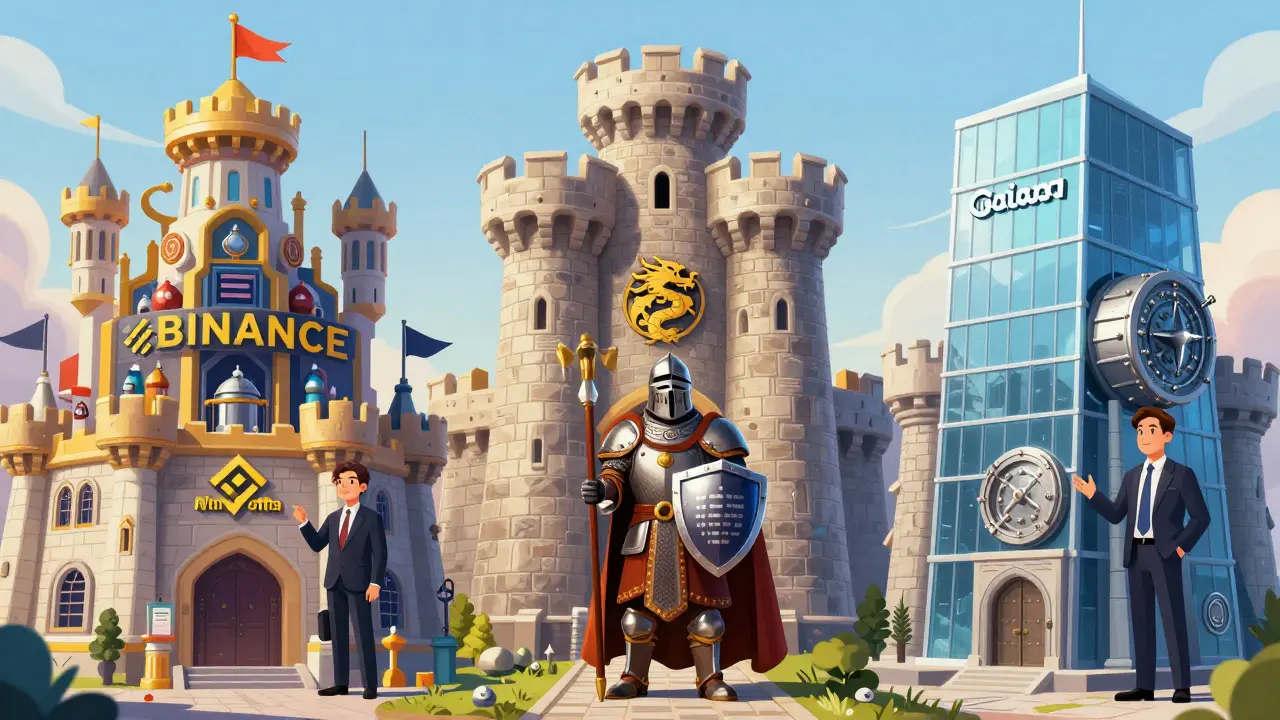
Kraken is a veteran cryptocurrency exchange founded in 2013, renowned for its strong security record and professional-grade trading features. Under CEO Dave Ripley, who succeeded founder Jesse Powell in 2022, Kraken has doubled down on its identity as the secure choice. Powell built Kraken because existing platforms were vulnerable. Ripley maintains that ethos while expanding into 190 countries.
Kraken’s approach is distinctively multi-jurisdictional. They hold licenses in Europe, Canada, the UK, Australia, Japan, and the US. This isn't just paperwork; it allows them to offer services locally that others cannot. For example, their staking services faced SEC lawsuits in the US, leading to a $30 million settlement and a pause on certain offerings. Yet, they continue to operate legally in other regions. This fragmentation means your experience depends heavily on your location. A user in London might have access to different products than one in New York.
Why does this matter to you? Because security often comes with friction. Kraken’s KYC processes are thorough. Their customer support is generally rated higher than competitors, but their interface can feel dated compared to newer apps. If your priority is keeping your funds safe and having a platform that stands up to legal challenges, Kraken is a strong candidate. They don't chase every trendy token; they prioritize established assets and robust infrastructure.
Coinbase: The Public Market Play
Coinbase is a publicly traded American cryptocurrency exchange, serving as a primary gateway for retail and institutional investors in the US. CEO Brian Armstrong has consistently pushed for Coinbase to be viewed as a financial institution first and a crypto company second. This strategy paid off during the regulatory shifts of 2025. With clearer rules emerging under the new administration, Coinbase is well-positioned to capture institutional inflows.
Coinbase dominates in the US, UK, and Europe due to its clean regulatory credentials. For beginners, it offers the easiest on-ramp. Buying crypto with a credit card or bank transfer is seamless, often free or low-cost. However, this convenience has a price. Fees for active traders can be significantly higher than on Binance or Kraken. If you are moving large volumes frequently, the cost adds up quickly.
The trade-off is trust and accessibility. Coinbase’s public listing means it undergoes regular financial audits. You know exactly how much cash backs your holdings. This transparency appeals to conservative investors and those wary of the opaque balance sheets of private exchanges. If you are new to crypto or prefer a hands-off approach where you want your exchange to act like a brokerage, Coinbase is likely your best fit.
Emerging Hubs: Malaysia and Global Expansion
While US-centric narratives dominate headlines, other regions are making moves. Malaysia, under Digital Minister Gobind Singh Deo, has emerged as a crypto-friendly hub. The goal? To become a top 20 global startup hub by 2030. The Malaysian Securities Commission granted licenses to new digital asset exchanges in 2024 and launched a regulatory sandbox. This creates opportunities for exchanges to test innovative products like tokenized bonds without full-scale regulatory burden.
For users in Southeast Asia or digital nomads traveling the region, this matters. Platforms operating in Malaysia may offer lower fees, faster withdrawals, and access to unique local assets. It also highlights a trend: regulation is becoming localized. An exchange that is banned in one country might be thriving in another. Always check if your preferred platform holds a license in your specific jurisdiction. Relying on a global brand name isn't enough if they aren't legally permitted to serve you locally.
Choosing Your Platform: A Decision Framework
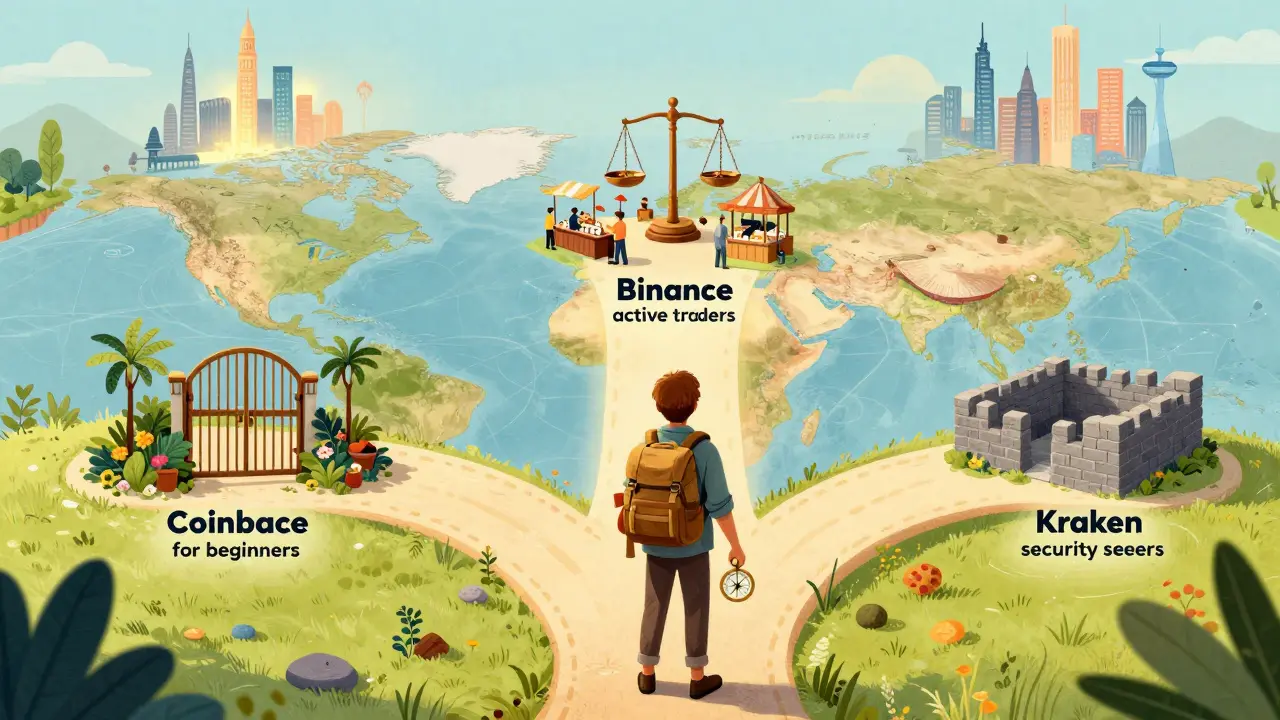
So, which exchange should you use? There is no single answer. It depends on your profile. Here is a simple breakdown:
- The Beginner: Prioritize ease of use and safety. Go with Coinbase. The higher fees are worth the peace of mind and simple interface.
- The Active Trader: Look for low fees and deep liquidity. Binance offers the best tools and lowest costs, provided you are comfortable with stricter verification.
- The Security Paranoiac: Choose Kraken. Their history of never being hacked and strong legal standing makes them ideal for long-term storage.
- The International Nomad: Research regional hubs like Malaysia or Singapore-based exchanges that offer favorable tax treatments and licensing.
Remember, diversification applies to exchanges too. Don't keep all your eggs in one basket. Use one platform for trading, another for cold storage, and perhaps a third for earning yield. Monitor the news. When a CEO changes or a new regulation passes, it affects your account. Stay informed, stay compliant, and trade safely.
Is Binance still safe to use in 2026?
Yes, Binance remains one of the most secure platforms globally, though it operates under strict regulatory oversight. CEO Richard Teng has focused heavily on compliance since taking over. While past legal issues exist, the exchange has implemented robust security measures and transparent reporting. Users should ensure they complete full KYC verification to maintain access.
How did the SEC leadership change affect crypto exchanges?
The resignation of Gary Gensler and appointment of Paul Atkins in early 2025 shifted the regulatory tone from aggressive enforcement to clearer guidelines. This allowed exchanges like Coinbase and Kraken to settle cases and resume certain services, such as staking, with greater certainty. It reduced the risk of sudden bans and encouraged institutional investment.
Which exchange has the lowest fees for beginners?
Coinbase often offers free or low-cost buying for small amounts via debit cards or bank transfers, making it attractive for beginners. However, for larger trades, Binance typically offers lower maker/taker fees. Kraken falls in the middle, with competitive rates for advanced users but simpler pricing for basic buys.
Can I use Kraken if I live outside the US?
Absolutely. Kraken operates in 190 countries and holds licenses in Europe, Canada, the UK, Australia, and Japan. In fact, non-US users often have access to a wider range of features, including certain staking products that are restricted in the United States due to ongoing legal disputes.
What role do FATF regulations play for individual traders?
The Financial Action Task Force (FATF) sets global standards for anti-money laundering. For individual traders, this means exchanges must verify your identity and monitor transactions. While this reduces anonymity, it protects you from fraud and ensures your exchange can work with traditional banks, preventing frozen withdrawals.