

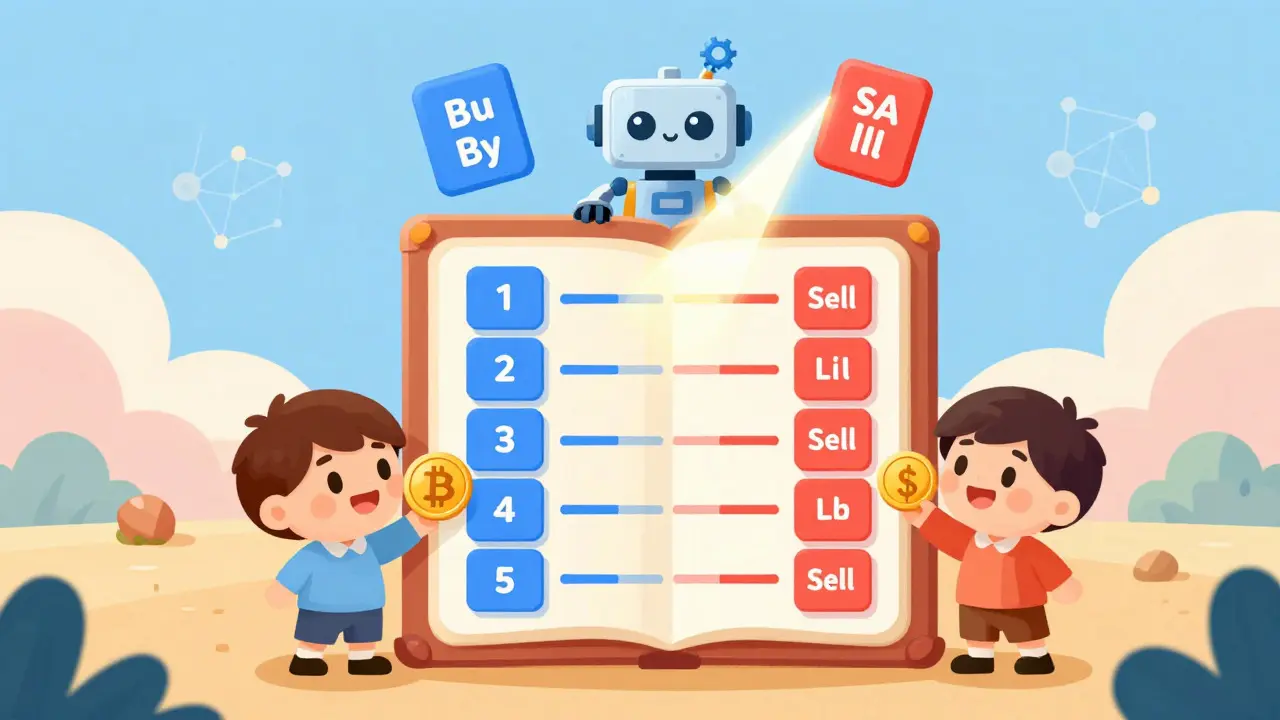
Imagine placing a limit order for Bitcoin at $65,000 and knowing exactly where it sits in the queue relative to every other trader. You don't have to trust a middleman with your funds or guess how an algorithm calculated the price. This is the core promise of Decentralized Exchange Order Books, which function as transparent, on-chain ledgers that match buy and sell orders without central authority intervention. Unlike Automated Market Maker (AMM) models like Uniswap, which use mathematical formulas to determine prices from pooled liquidity, order book DEXs rely on direct interaction between buyers and sellers. For professional traders and institutions entering the DeFi space in 2026, this distinction is critical because it offers precise price discovery and control over execution, though it comes with its own set of technical and liquidity challenges.
The Core Mechanics: Matching Engines and Priority
At its heart, an order book DEX consists of two main components: the ledger itself and the matching engine. The ledger maintains a real-time list of all active orders. Buy orders are sorted from highest to lowest price, while sell orders are listed from lowest to highest. When the top bid meets the top ask, a trade executes automatically. The matching engine acts as the brain of this system, processing these interactions according to specific rules.
The standard rule here is price-time priority. If two traders place buy orders at the same price, the one who placed their order first gets filled first. This mechanism mirrors traditional stock exchanges but operates through smart contracts or hybrid systems. In fully on-chain implementations, the entire process happens directly on the blockchain. In hybrid models, such as those used by dYdX v3, matching occurs off-chain for speed, while settlement happens on-chain for security. This dual-component structure ensures that trades are fair and verifiable, reducing the risk of manipulation that can occur in opaque centralized systems.
Order Book DEXs vs. AMMs: A Structural Comparison
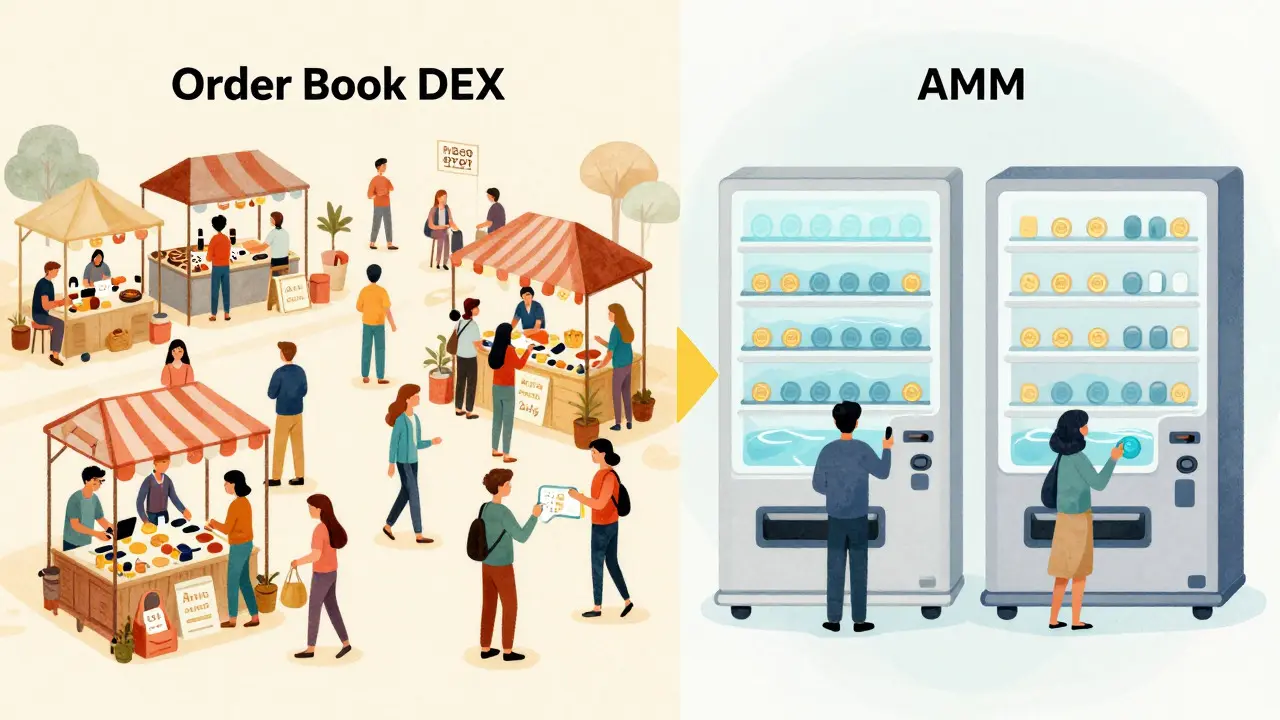
To understand why order books matter, you have to look at what they replace. Most DEXs today use Automated Market Makers (AMMs). In an AMM, liquidity providers deposit assets into pools, and prices are determined by a constant product formula (x * y = k). When you swap tokens, you interact with the pool, not another user. This creates a homogeneous experience where executions are handled pro rata against all liquidity providers.
Order book DEXs work differently. Orders retain their separate identities. You aren't swapping against a generic pool; you're trading against specific counterparties whose orders are visible on the book. This leads to superior price discovery because the price reflects actual supply and demand rather than an algorithmic approximation. However, this transparency comes at a cost. AMMs provide instant liquidity for any asset pair, no matter how obscure. Order books require active market makers to place limit orders on both sides of the trade. Without them, the book becomes thin, spreads widen, and slippage increases significantly, especially for low-volume pairs.
| Feature | Order Book DEX | AMM-based DEX |
|---|---|---|
| Pricing Mechanism | Direct buyer-seller interaction | Mathematical formula (constant product) |
| Liquidity Source | Active market makers & traders | Passive liquidity pools |
| Price Discovery | High precision, market-driven | Approximate, algorithm-driven |
| Best For | Professional trading, high volume | Simple swaps, long-tail assets |
| Complexity | Higher (requires market making) | Lower (instant access) |
Architectural Approaches: On-Chain, Off-Chain, and Hybrid
Not all order book DEXs are built the same way. The architecture determines how fast trades execute and how decentralized the system truly is. There are three primary models used in the industry:
- Fully On-Chain: Every order placement, cancellation, and trade execution happens on the blockchain. This offers maximum transparency and censorship resistance but suffers from high gas fees and slow speeds due to blockchain throughput limits (e.g., Ethereum's base layer constraints).
- Off-Chain Matching with On-Chain Settlement: The matching engine runs off-chain to handle thousands of transactions per second. Once a trade is matched, the result is signed and submitted to the blockchain for final settlement. This is the model used by projects like dYdX and Loopring, offering a balance of speed and security.
- Hybrid Models: These combine elements of both, often using Layer 2 solutions like zkRollups or Optimistic Rollups to compress data and reduce costs while maintaining cryptographic guarantees.
In 2026, the trend is heavily leaning toward hybrid and Layer 2 solutions. Fully on-chain order books remain niche due to economic inefficiencies, while pure off-chain models face criticism for potential centralization risks if the operator isn't sufficiently decentralized.
Liquidity Challenges and Market Making
The biggest hurdle for order book DEXs is liquidity concentration. In an AMM, anyone can add liquidity to a pool with a single click. In an order book, you need sophisticated actors-market makers-to continuously quote bids and asks. If these market makers pull out during volatile periods, the spread can blow up, making it expensive for regular users to trade.
This dynamic means that order book DEXs excel in high-volume, blue-chip assets like ETH/USDC or BTC/ETH, where institutional interest keeps the books deep. For smaller altcoins, however, the experience can be frustrating. Users often report wide bid-ask spreads and significant slippage during low-volume hours. To mitigate this, many platforms offer fee rebates to market makers, incentivizing them to keep quotes tight. Understanding this incentive structure is crucial for traders; you are effectively paying a premium for the precision that only an order book can provide.

User Experience and Technical Requirements
Using an order book DEX requires a steeper learning curve than interacting with an AMM. You need to understand concepts like limit orders, market orders, partial fills, and order book depth. For beginners, the interface can feel intimidating compared to the simple "swap" button found on Uniswap. However, for experienced traders, this complexity is a feature, not a bug. It allows for advanced strategies like stop-losses, take-profits, and iceberg orders that hide large positions to avoid moving the market.
From a technical standpoint, users must manage their own wallets and ensure they have sufficient gas tokens for the specific network. While hybrid models have reduced gas costs significantly, they are rarely zero. Additionally, front-running remains a concern in some environments, although newer protocols use private mempools or sequencer mechanisms to protect order integrity. The trade-off is clear: you give up the simplicity of AMMs in exchange for professional-grade trading tools and non-custodial control.
Future Outlook and Industry Adoption
As DeFi matures, the line between centralized and decentralized trading is blurring. Institutional investors are demanding features that mirror traditional finance, such as derivatives trading and precise execution. Order book DEXs are positioned to capture this segment. Projections suggest that as Layer 2 technology improves and regulatory clarity increases, order book models will gain further share in the DEX market, particularly for complex financial instruments.
We are likely to see more convergence between the two models. Some AMM protocols are experimenting with order book overlays, while order book DEXs are integrating liquidity aggregation from AMMs to backstop their books. The future isn't about one model replacing the other; it's about creating hybrid ecosystems that offer the best of both worlds: the accessibility of AMMs and the precision of order books.
What is the main advantage of using an order book DEX over an AMM?
The main advantage is precise price discovery and control. Order books allow traders to see exact bid and ask prices and place limit orders, ensuring they get their desired execution price. AMMs, by contrast, use algorithms to determine prices based on pool liquidity, which can lead to slippage for larger trades.
Are order book DEXs better for beginners?
Generally, no. AMMs are simpler and more intuitive for beginners because they abstract away the complexity of order management. Order book DEXs require knowledge of trading mechanics like limit orders and market depth, making them better suited for intermediate to advanced traders.
How do gas fees affect order book DEX usage?
Gas fees can make frequent order placement and cancellation expensive, especially on Layer 1 networks. This discourages small, frequent adjustments to orders. Hybrid models and Layer 2 solutions have largely solved this by drastically reducing transaction costs, making order book trading viable for retail users.
What is price-time priority in a DEX order book?
Price-time priority is the rule used by the matching engine to determine the order of execution. Orders with the best price are filled first. If multiple orders have the same price, the one placed earliest in time is filled first. This ensures fairness and prevents later orders from jumping ahead of earlier ones at the same price level.
Can I trade illiquid assets on an order book DEX?
You can, but it may be difficult. Illiquid assets often have thin order books, meaning few active buyers and sellers. This results in wide spreads and high slippage. For very obscure assets, AMMs are usually a better option because they aggregate liquidity from passive providers, whereas order books require active market participation.