


Most crypto traders know the frustration: you want to swap Bitcoin for TRON tokens, but your wallet only connects to one chain. You need bridges, wrapped assets, or worse - a centralized exchange that holds your keys. That’s where HDEX claims to solve the problem. Built on Bluehelix’s cross-chain infrastructure, HDEX lets you trade BTC, ETH, BSC, TRON, HECO, and DOGE directly - no custodians, no intermediaries. But does it actually work in practice? And is it worth using in 2026?
What HDEX Actually Does
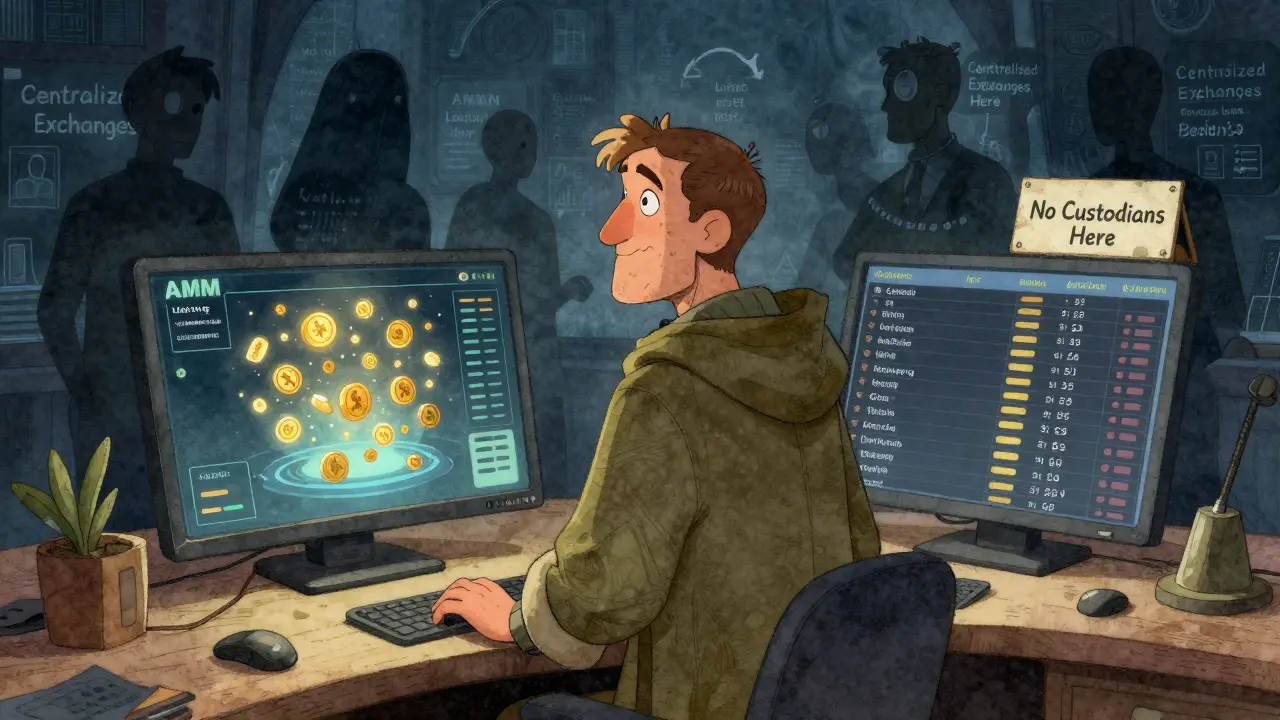
HDEX isn’t just another DEX. It’s one of the few that natively supports six major blockchains at once. Most decentralized exchanges stick to one chain - Uniswap on Ethereum, PancakeSwap on BSC. HDEX flips that. You can trade Dogecoin for Ethereum without leaving the platform. No need to bridge assets, no waiting for confirmations across chains. It uses the Bluehelix Chain OpenDEX protocol to make atomic swaps happen between networks that normally can’t talk to each other.
That’s powerful. If you’re holding assets on different chains - say, BTC in a hardware wallet and ETH in MetaMask - HDEX removes the middleman. You keep full control. No exchange holds your private keys. That’s a big deal after FTX, Celsius, and other custodial collapses shattered trust.
How Trading Works on HDEX
HDEX doesn’t force you into one trading style. It offers two systems side by side:
- Automated Market Maker (AMM): Like Uniswap. You swap tokens against a liquidity pool. Prices adjust automatically based on supply and demand.
- Orderbook: Like Binance or Kraken. You place limit orders, stop-losses, or market orders. This is rare in DEXs. Most don’t even try.
This hybrid setup is smart. New users can stick with AMM - simple, one-click swaps. More experienced traders can use limit orders to time entries or exits. You don’t have to jump between platforms. That’s a real advantage over Uniswap or SushiSwap, which only offer AMM.
But here’s the catch: the orderbook doesn’t have deep liquidity. You’ll see wide spreads and slippage on larger trades. It works fine for small swaps, but don’t expect to move $10,000 in ETH without moving the market.
Supported Chains and Assets
HDEX officially supports:
- Bitcoin (BTC)
- Ethereum (ETH)
- Binance Smart Chain (BSC)
- Huobi ECO Chain (HECO)
- TRON (TRX)
- Dogecoin (DOGE)
That’s a solid list. It covers the most-used chains for DeFi, NFTs, and memecoins. But it’s not expanding fast. There’s no sign of Solana, Polygon, or Avalanche - even though they’re bigger than HECO now. The roadmap says it’ll add more chains “based on demand,” but demand seems low. No major updates since late 2023.
One oddity: Bitcoin doesn’t have smart contracts. HDEX still lets you trade BTC. That means it’s using a wrapped version (like HBTC) on the Bluehelix chain. That introduces a tiny bit of centralization risk - if the bridge fails, your BTC is locked. Not as bad as centralized exchanges, but not fully trustless either.
How It Compares to the Big Players
Let’s be clear: HDEX isn’t competing with Coinbase or Kraken. It’s trying to compete with Uniswap, 1inch, and PancakeSwap. Here’s how it stacks up:
| Feature | HDEX | Uniswap V3 | PancakeSwap | 1inch |
|---|---|---|---|---|
| Supported Chains | 6 (BTC, ETH, BSC, HECO, TRON, DOGE) | Ethereum + Layer-2s (Arbitrum, Optimism) | BSC only | 15+ chains (aggregator) |
| Trading Types | AMM + Orderbook | AMM only (concentrated liquidity) | AMM only | AMM + aggregation |
| 2024 Trading Volume | Not publicly tracked | $320 billion | $98 billion | $47 billion |
| Liquidity Depth | Low - small pools | Very high | High | Very high |
| User Base (Monthly) | Unknown - no public stats | 2.5 million | 1.8 million | 1.1 million |
| Order Types | Limit, Stop, Market | Market only | Market only | Market only |
HDEX’s biggest edge? The orderbook. No other DEX on this list gives you that flexibility on multiple chains. But its biggest weakness? Liquidity. You’re trading against shallow pools. Slippage is real. And if you’re swapping large amounts, you’ll get crushed.
Security and Risk
HDEX is non-custodial. That’s good. Your keys stay in your wallet. No one can freeze your assets. No KYC. No account freezes. But that doesn’t mean it’s safe.
There are no public audit reports. No third-party security review from firms like CertiK or Hacken. That’s a red flag. Cross-chain bridges are the most exploited part of DeFi. In 2024, the Multichain bridge lost $600 million. HDEX’s own bridge isn’t documented. If it fails, your assets vanish.
Also, HBC tokens are used to reward ambassadors. But there’s no info on token distribution, supply, or use cases. Is it a governance token? A utility token? No whitepaper clarifies this. That’s unusual for a platform claiming to be decentralized.

Who Is HDEX For?
HDEX isn’t for beginners. If you’re new to crypto, stick with Coinbase or Kraken. HDEX requires:
- A wallet that supports multiple chains (MetaMask, Trust Wallet, etc.)
- Understanding of gas fees on each chain (you need BTC for Bitcoin, BNB for BSC, etc.)
- Patience - transactions can fail if a chain is congested
- Willingness to accept low liquidity and wide spreads
It’s ideal for someone who:
- Holds assets across several chains and wants to swap without bridging
- Wants limit orders on a DEX
- Values non-custodial control
- Is okay with experimental tech and low volume
If you’re trading daily, HDEX isn’t your main exchange. But if you occasionally need to swap DOGE to TRON, it’s one of the few places you can do it without leaving your wallet.
The Bottom Line
HDEX has a real idea: cross-chain trading without custody. It’s ahead of most DEXs in that regard. The orderbook feature is a standout. But it’s stuck in early adoption. Liquidity is thin. No audits. No clear roadmap. No user growth data.
It’s not a replacement for Uniswap or PancakeSwap. It’s a niche tool for a specific use case. If you need to swap between these six chains without touching a centralized exchange, HDEX might be your best bet. But if you’re looking for reliability, volume, or safety - look elsewhere.
The crypto world is moving toward cross-chain solutions. Gartner predicts 60% of DeFi volume will span multiple chains by 2026. HDEX is trying to get there early. But without more liquidity, audits, and transparency, it risks being a footnote - not a leader.
Is HDEX a centralized or decentralized exchange?
HDEX is a decentralized exchange (DEX). It doesn’t hold your funds. You trade directly from your wallet using smart contracts. No KYC, no account freezes. But it does use bridges to move assets between chains - and those bridges introduce some centralization risk if not fully audited.
Can I trade Bitcoin on HDEX?
Yes. HDEX supports Bitcoin (BTC) alongside Ethereum, BSC, TRON, and others. However, BTC is traded as a wrapped token (like HBTC) on the Bluehelix chain. This means your BTC isn’t directly moved - it’s locked and represented as a token on another chain. It’s not as trustless as a native swap, but better than using a centralized exchange.
Does HDEX have a mobile app?
No. HDEX has no official mobile app. You must use it through a web browser with a Web3 wallet like MetaMask or Trust Wallet. There’s no native iOS or Android app, which makes it less accessible for casual users.
Is HDEX safe to use?
It’s as safe as any DEX - meaning, you control your keys. But safety here is risky. There are no public security audits. The cross-chain bridge isn’t documented. No one knows if it’s been tested. If the bridge fails, your assets could be lost. Use only small amounts until more transparency emerges.
How do I get started with HDEX?
First, install a multi-chain wallet like MetaMask. Add the Bluehelix Chain network manually (you’ll need the RPC URL from HDEX’s website). Then, send some ETH, BNB, or other gas tokens to cover fees. Connect your wallet to HDEX’s website, and start swapping. There’s no sign-up. No KYC. Just connect and trade.
Does HDEX support futures or leverage trading?
No. HDEX only offers spot trading. You can buy and sell assets at current market prices or place limit orders. There are no margin trading, futures, or leverage options. That makes it simpler but limits its appeal for active traders who want to go long or short.
Why is HDEX not listed on major exchange comparison sites?
Because it lacks volume, user data, and transparency. Sites like Token Metrics and DappRadar track trading volume and active users. HDEX doesn’t publish either. Without proof of usage or security, it’s not considered a top-tier option. It’s still too early to judge - but right now, it’s a fringe player.
Shannon Holliday
March 3, 2026 AT 13:55Don B.
March 5, 2026 AT 02:03Mary Scott
March 6, 2026 AT 18:15Leslie Cox
March 6, 2026 AT 23:28Sriharsha Majety
March 7, 2026 AT 15:57Andrew Hadder
March 9, 2026 AT 07:18Molley Spencer
March 9, 2026 AT 16:37Samantha Stultz
March 10, 2026 AT 21:17Ifeanyi Uche
March 12, 2026 AT 15:47Kenneth Genodiala
March 13, 2026 AT 19:06Danny Kim
March 14, 2026 AT 14:22Vishakha Singh
March 14, 2026 AT 17:28Derek Sasser
March 15, 2026 AT 14:03Michael Rozputniy
March 16, 2026 AT 21:13Cathy Sunshine
March 17, 2026 AT 07:37Jeremy buttoncollector
March 17, 2026 AT 18:26