

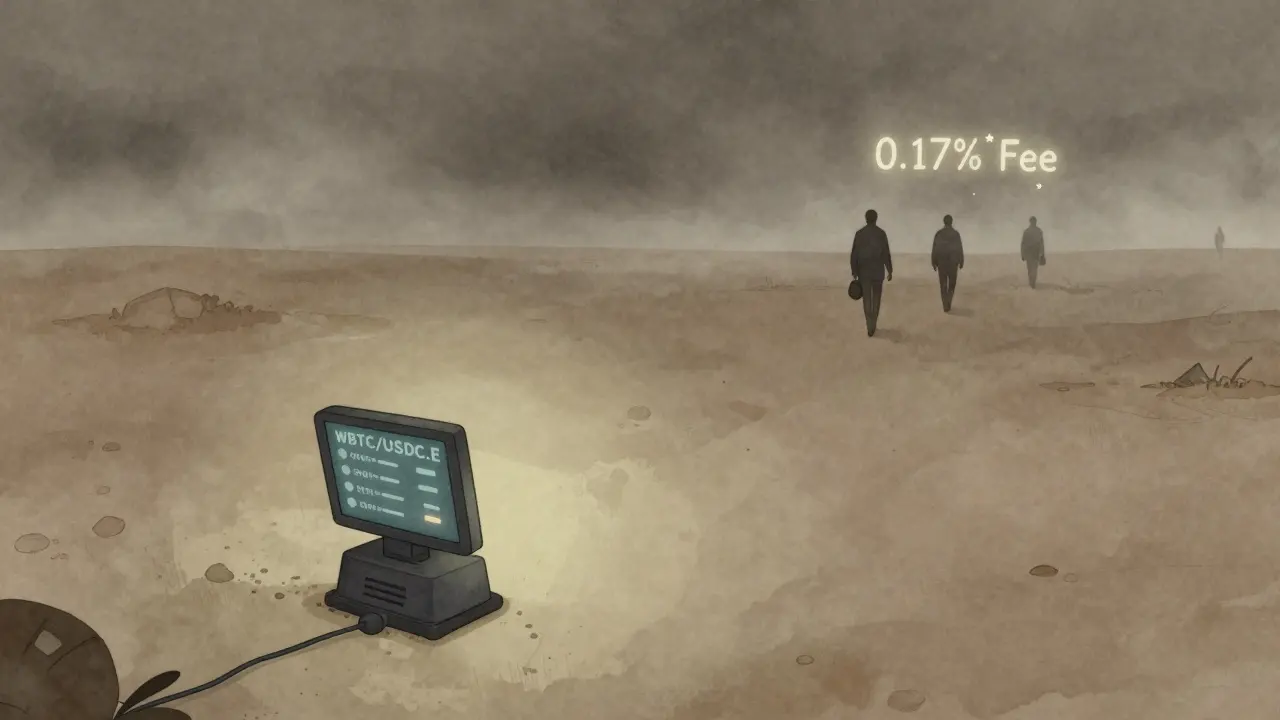
When you hear "one of the lowest trading fees in the market," you might picture a crypto exchange that’s fast, reliable, and full of traders. But with MM Finance (Arbitrum), that promise doesn’t match the reality. Launched in 2023 as a move from Cronos and Polygon to Arbitrum, this platform claims to be a top-tier decentralized exchange. The truth? It’s barely alive.
What MM Finance (Arbitrum) Actually Offers
MM Finance (Arbitrum) is a decentralized exchange (DEX) built on Arbitrum, a Layer-2 scaling solution for Ethereum. It uses an automated market maker (AMM) model, meaning trades happen through liquidity pools instead of order books. The platform’s main selling point is a 0.17% trading fee - lower than the industry standard of 0.3% on Uniswap or SushiSwap. That sounds great on paper. But here’s the catch: you can’t trade much of anything. As of October 2023, MM Finance (Arbitrum) had just one trading pair: WBTC/USDC.E. That’s it. No ETH, no SOL, no stablecoin pairs beyond that. No altcoins. No margin trading. No options or derivatives - despite what the site claims. If you’re trying to swap your USDC for something else, you’re out of luck unless you’re specifically trading wrapped Bitcoin. The platform’s native token, MMF, is supposed to handle governance and yield farming. But with almost no trading volume, there’s no real demand for the token. Liquidity pools are tiny. The bid and ask depth at ±2% from the current price? Just $27 on each side. That means even a $100 trade could slip by 10% or more. For comparison, Uniswap v3 on Arbitrum handles over $100 million in volume daily. MM Finance? $5.56.Why the Arbitrum Network Doesn’t Save It
Arbitrum itself is a powerhouse. With over $9.6 billion locked in DeFi protocols and $220 million in daily DEX volume, it’s one of the most active Layer-2 chains. Major projects like Aave, Chainlink, and The Graph are built here. So why hasn’t MM Finance caught on? Because low fees don’t matter if there’s no liquidity. Traders don’t care about saving 0.13% if they can’t execute their trades without losing 5% to slippage. The Arbitrum network reduces gas fees by 90-95% compared to Ethereum mainnet, but MM Finance doesn’t leverage that advantage to attract users - it just sits there with one trading pair and zero community. Even on Arbitrum, the top DEXs dominate. Uniswap v3 controls 58% of volume. Camelot has 12%. SushiSwap has 8%. MM Finance? It’s not even on the radar. Its daily volume is 0.0025% of Arbitrum’s total DEX activity. That’s not a startup - that’s a ghost.The User Experience: A Dead End
To use MM Finance (Arbitrum), you need a Web3 wallet like MetaMask configured for the Arbitrum network. You’ll have to bridge your funds from Ethereum - a process that takes minutes to hours. Then you’ll land on a clean interface with one trading pair, no tutorials, and no help section. There are no YouTube guides. No Medium articles. No Discord community. No Twitter engagement - just 38 followers. No customer support channels. No FAQ page. If you get stuck, you’re on your own. Even experienced DeFi users would walk away after realizing they can’t trade anything meaningful. Compare that to Uniswap or Camelot, which have active forums, community-run tutorials, and responsive support. MM Finance feels like a prototype that was abandoned after the first version.
Is MMF Token Worth It?
The MMF token is listed as a governance and farming token. But with no liquidity pools to farm, no staking mechanisms, and no active DAO, it’s essentially worthless. You can’t earn meaningful yields because there’s no volume to generate fees. No one is voting on proposals because no one is using the platform. Tokenomics alone can’t save a DEX. If users aren’t trading, the token has no utility. It’s not a speculative asset - it’s a digital placeholder.What’s Missing? Everything
MM Finance (Arbitrum) claims to support NFTs and derivatives. But there’s no NFT marketplace. No derivative markets. No charting tools. No advanced order types. No mobile app. No API. No analytics dashboard. The platform doesn’t just lack features - it lacks the basic infrastructure most DEXs take for granted. Even small DEXs like Trader Joe or Curve have dozens of trading pairs, active communities, and regular updates. MM Finance hasn’t released a single update since its launch. Its CoinGecko page hasn’t changed in months. No new pairs. No new features. No marketing. No transparency.
Gene Inoue
March 21, 2026 AT 03:17Ricky Fairlamb
March 21, 2026 AT 19:05Arlene Miles
March 23, 2026 AT 10:06Jessica Beadle
March 24, 2026 AT 17:54Tony Weaver
March 24, 2026 AT 19:13Patty Atima
March 25, 2026 AT 16:55Lucy de Gruchy
March 26, 2026 AT 00:04Lauren J. Walter
March 26, 2026 AT 06:33Carol Lueneburg
March 26, 2026 AT 15:19Brenda White
March 27, 2026 AT 20:54Tobias Wriedt
March 28, 2026 AT 09:06Ernestine La Baronne Orange
March 28, 2026 AT 09:26Manali Sovani
March 29, 2026 AT 22:39Konakuze Christopher
March 30, 2026 AT 21:53S F
March 31, 2026 AT 13:37Angelica Stovall
April 2, 2026 AT 04:59Taylor Holloman.
April 2, 2026 AT 23:26Sarah Zakareckis
April 3, 2026 AT 15:26Sarah Hammon
April 4, 2026 AT 00:20iam jacob
April 5, 2026 AT 23:04Jesse Pals
April 7, 2026 AT 11:02Diane Overwise
April 8, 2026 AT 23:23Ann Liu
April 10, 2026 AT 04:09Dionne van Diepenbeek
April 11, 2026 AT 11:48