


QuickSwap v4 on Base isn’t just another decentralized exchange. It’s a response to the frustrating reality of Ethereum’s gas fees and slow confirmations - especially for small traders. If you’ve ever waited 10 minutes for a $50 swap to go through, only to pay $15 in fees, you already know why this platform exists. QuickSwap v4, launched in early 2024 as a Layer 2 solution on Coinbase’s Base blockchain, cuts through that noise. It’s fast, cheap, and built for people who trade regularly but don’t have institutional budgets.
How QuickSwap v4 on Base Actually Works
QuickSwap started in 2020 as a fork of Uniswap, designed to solve Ethereum’s high costs. But it wasn’t until it moved to Base in 2023 that it found its real purpose. Base is an Optimistic Rollup built on the OP Stack, meaning it bundles hundreds of transactions into one Ethereum batch. This gives it a throughput of 2,000 transactions per second - compared to Ethereum’s 15-45. That’s not theory. That’s what happens when you swap USDC for WETH.
On QuickSwap v4, swaps take an average of 2.1 seconds. During peak times, the 95th percentile is under 4.5 seconds. That’s faster than most centralized exchanges load their charts. And the cost? As low as $0.01 per trade. Compare that to Ethereum mainnet, where even simple swaps can cost $4-$15. For retail traders making small, frequent moves, this isn’t a feature - it’s a necessity.
The engine behind the scenes is StratEx, an AI analytics tool launched in Q2 2025. It doesn’t predict prices, but it does analyze historical patterns to suggest optimal trade timing. Backtested against 18 months of data, it hit 78.4% accuracy in predicting favorable entry points. That’s not a magic bullet, but for someone watching a token dip and wondering if it’s a trap or a bounce, it’s a useful nudge.
Trading Pairs, Liquidity, and Slippage
QuickSwap v4 supports over 1,200 trading pairs across multiple chains - but on Base itself, you’re mostly dealing with ERC-20 tokens. The most active pair is WETH/USDC, which accounts for nearly 70% of daily volume. That’s good news: it means tight spreads and low slippage for the most common trades.
But here’s the catch: liquidity depth. For major pairs like ETH/USDC, QuickSwap v4 has 37% less liquidity than Uniswap v3 on Ethereum. That doesn’t matter for a $100 swap. But if you’re trying to move $10,000, expect around 0.18% slippage. On Uniswap, it’s closer to 0.12%. Not a huge gap - but noticeable. For trades over $50,000, slippage jumps past 1.5%. That’s a dealbreaker for institutions.
That’s why QuickSwap v4 on Base is perfect for micro-trades. Dune Analytics shows 63% of all swaps under $50 on Base happen here. Retail users love it because they can swap $75 of USDC to ETH for $0.011 in gas. That’s the sweet spot. It’s not built for whales. It’s built for the everyday trader who doesn’t want to pay a coffee’s worth in fees just to get in and out.
Speed, Fees, and What You Actually Pay
Let’s break down the real numbers:
- Trading fee: 0.30% flat (same as most DEXs)
- Gas fee on Base: $0.012 average (vs. $4.37 on Ethereum)
- Swap time: 1.8 seconds average, 4.3 seconds max
- API response: 187ms average
Most DEXs charge similar trading fees. The difference isn’t in the percentage - it’s in the gas. On Ethereum, even a 0.05% fee can cost you $2 if gas is high. On Base, that same trade costs $0.01. That’s why QuickSwap v4 dominates Base’s DEX volume, holding 14.3% share despite Uniswap’s 58.2% lead. Users aren’t choosing it for features - they’re choosing it because it’s the cheapest way to move money.
And the speed? It’s not just fast - it’s snappy. Open the app, connect your wallet, pick your tokens, confirm - and you’re done before your coffee cools. That’s the kind of experience that turns occasional users into daily traders.

What’s Missing: Advanced Features
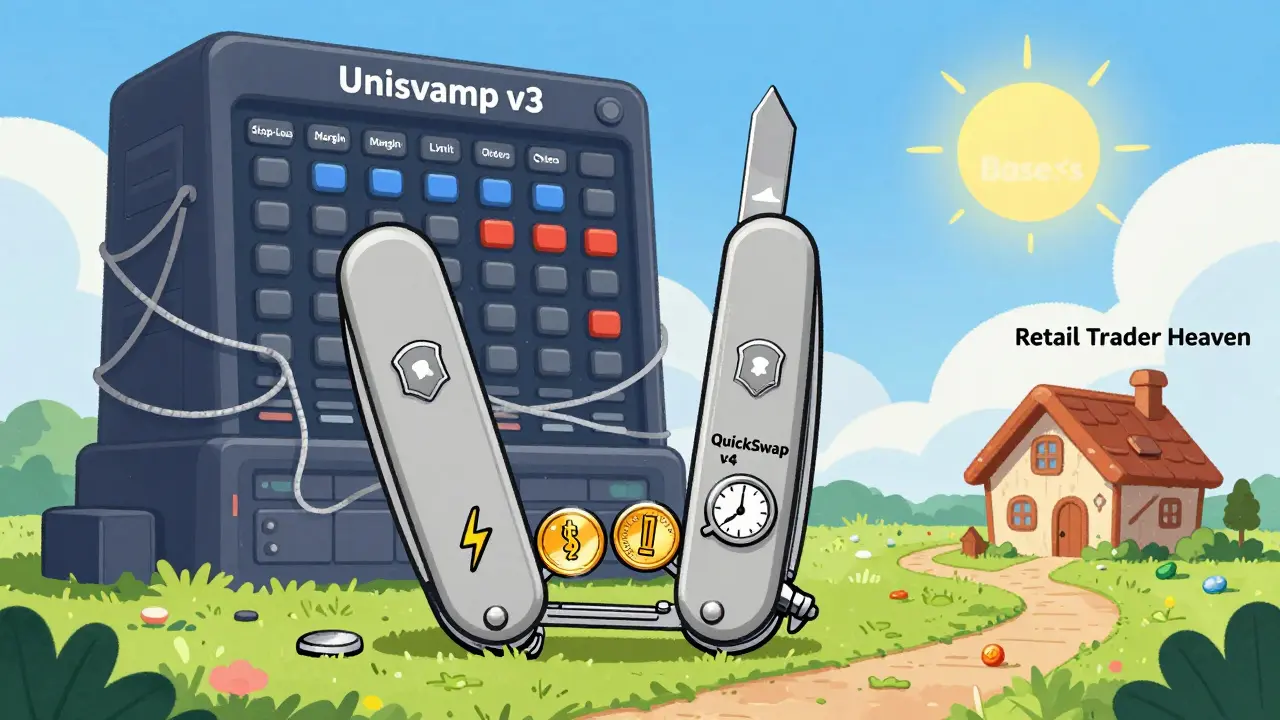
QuickSwap v4 isn’t trying to be a full-featured trading terminal. There are no limit orders. No stop-losses. No trailing stops. No margin trading - at least not yet. The platform is barebones by design. It’s focused on one thing: making swaps cheap and instant.
That’s why users on Reddit and Trustpilot give it high ratings for simplicity, but low marks for functionality. One user wrote: “I love the fees, but I can’t set a stop-loss. That makes serious trading impossible.” And they’re right. If you’re trying to automate a strategy or hedge a position, QuickSwap v4 won’t help. You’ll need to use a centralized exchange like Binance or Kraken for those tools.
But if you’re a retail trader who buys small amounts of new tokens, swaps between stablecoins, or farms yield on weekends - this is your tool. It’s the Swiss Army knife for micro-transactions, not the command center for institutional trading.
Security and Reliability
Security on QuickSwap v4 is solid, not flashy. The treasury is managed with Gnosis Safe multi-sig. Contracts have been audited by OpenZeppelin as recently as September 2025. There’s a $150,000 bug bounty through Immunefi. Those aren’t empty promises - they’re industry-standard protections.
Base itself is backed by Coinbase, which adds a layer of institutional credibility. Unlike some Layer 2s built by anonymous teams, Base has a clear roadmap, active development, and corporate backing. That matters. It means updates are consistent, bugs get patched fast, and the network won’t vanish overnight.
Still, there’s a risk: QuickSwap’s success is tied to Base’s growth. If Base loses users to Arbitrum or Optimism, QuickSwap will too. Analysts at Delphi Digital call this a “single-point-of-failure risk.” That’s fair. But for now, Base is growing fast - 4 million weekly active addresses as of Q3 2025, up 63% year-over-year.
Getting Started: How to Use QuickSwap v4 on Base
Setting up takes less than 10 minutes:
- Install a Web3 wallet: MetaMask, Coinbase Wallet, or Trust Wallet.
- Switch your network to Base (you can add it manually using the RPC details on Base’s official site).
- Deposit ETH or USDC. If you’re coming from Ethereum, use the Base Bridge V2 - it’s faster and cheaper than the old version.
- Go to app.quickswap.exchange and connect your wallet.
- Swap tokens. That’s it.
The interface is clean. No clutter. No confusing tabs. You pick a token, enter the amount, and click swap. If you’re new, QuickSwap has 47 tutorial videos and 127 written guides - all updated as recently as October 2025. You won’t get lost.
The only real hurdle is bridging assets from other chains. That can take 20-30 minutes. But once your funds are on Base, everything else is near-instant.
Who Should Use QuickSwap v4 on Base?
This isn’t for everyone. Here’s who it’s perfect for:
- Small traders: Swapping under $100 regularly? This is your home.
- Token farmers: Jumping between yield pools on Base? Low fees mean more profit.
- Base ecosystem users: If you’re using other apps on Base (like Pendle, Lyra, or Frax), this is your natural DEX.
- Beginners: Simple interface, no complex order types. Easy to learn.
It’s not for:
- Institutional traders: Slippage and lack of API limits make large trades risky.
- Advanced traders: No stop-losses, no limit orders, no leverage.
- Long-term holders: You don’t need a DEX to HODL.
The Future: What’s Coming
QuickSwap isn’t standing still. In October 2025, they launched QuickSwap Perps - a perpetual futures module with up to 20x leverage. It processed $427,000 in its first week. That’s a sign they’re listening to users who want more than just swaps.
The roadmap includes:
- QuickSwap Pay: Fiat on-ramp integration (Q1 2026)
- Smart Order Router v2: Reducing slippage by 30%
- Institutional API Suite: Higher rate limits, better data feeds (Q1 2026)
If they deliver, they’ll move from being a “good for small trades” tool to a serious contender. Right now, they’re the best option on Base for everyday users. With these updates, they could become the go-to for the entire retail DeFi crowd.
Final Verdict
QuickSwap v4 on Base is the most practical DEX for retail traders in 2026. It doesn’t try to be everything. It doesn’t need to. It’s fast, cheap, reliable, and built for the real world - where most people trade $50, not $50,000.
It’s not perfect. No liquidity depth for big trades. No advanced order types. But for what it does - moving small amounts of crypto quickly and affordably - it’s unmatched.
If you’re tired of paying $10 in fees to swap USDC for WETH, give it a try. Connect your wallet, bridge a little ETH, and make a $20 swap. You’ll see why so many users say: “Why was I using anything else?”
Is QuickSwap v4 on Base safe to use?
Yes. QuickSwap v4 uses audited smart contracts by OpenZeppelin, multi-sig treasury management via Gnosis Safe, and runs on Coinbase-backed Base, which has strong infrastructure and active development. There’s also a $150,000 bug bounty program through Immunefi. While no DeFi platform is 100% risk-free, QuickSwap v4 follows industry-standard security practices.
Can I use QuickSwap v4 without bridging assets?
You can only swap tokens that already exist on Base. If your assets are on Ethereum, Polygon, or Solana, you’ll need to bridge them using the Base Bridge V2. The bridge is secure and typically takes 20-30 minutes. Once your funds are on Base, you can trade instantly.
Does QuickSwap v4 support limit orders or stop-losses?
No. QuickSwap v4 only supports instant swaps. It does not offer limit orders, stop-losses, or any advanced trading tools. If you need those features, you’ll need to use a centralized exchange like Binance or Kraken. QuickSwap is designed for simple, low-cost swaps, not complex trading strategies.
How does QuickSwap v4 compare to Uniswap v3?
Uniswap v3 has far more liquidity and supports advanced features like concentrated liquidity positions, but it runs on Ethereum, where gas fees are high. QuickSwap v4 on Base has less liquidity but costs 99% less in fees and is 10x faster. For small trades under $100, QuickSwap is better. For large trades or complex strategies, Uniswap v3 is still the leader.
What’s the trading volume on QuickSwap v4 on Base?
As of October 2025, QuickSwap v4 on Base processed $2.75 million in 24-hour trading volume. It holds 14.3% of the total DEX volume on Base, making it the second-largest DEX on the network after Uniswap. Volume has grown rapidly since its launch, with daily trades up 366% in a single day at its peak.
Is the QUICK token worth holding?
The QUICK token has no utility on QuickSwap v4 - it’s not used for fees, governance, or staking. Its value is purely speculative. Some analysts warn it could be classified as a security by the SEC, which adds regulatory risk. Most users trade on QuickSwap without ever touching QUICK. Hold it only if you believe in its long-term price speculation, not its functionality.
Gavin Francis
February 2, 2026 AT 02:31Stop overcomplicating it.
Dylan Morrison
February 2, 2026 AT 14:24josh gander
February 2, 2026 AT 22:41Sunil Srivastva
February 4, 2026 AT 12:33Devyn Ranere-Carleton
February 6, 2026 AT 08:17Nickole Fennell
February 8, 2026 AT 02:43Edward Drawde
February 9, 2026 AT 15:53Richard Kemp
February 11, 2026 AT 03:50Gurpreet Singh
February 11, 2026 AT 22:07Christopher Michael
February 13, 2026 AT 12:03Parth Makwana
February 13, 2026 AT 23:29Elle M
February 14, 2026 AT 16:00Crystal Underwood
February 16, 2026 AT 14:21Raymond Pute
February 18, 2026 AT 07:28Jack Petty
February 19, 2026 AT 22:27Freddy Wiryadi
February 21, 2026 AT 16:11Brianne Hurley
February 22, 2026 AT 21:56christal Rodriguez
February 24, 2026 AT 08:48