


Trading cryptocurrency on Ethereum mainnet used to mean paying more in gas fees than the profit you’d make from the trade itself. That era is largely behind us, thanks to Layer 2 solutions like Optimism. But once you bridge your assets to Optimism, where do you actually swap them? This is where Velodrome Finance comes into play. It isn’t just another copy-paste of Uniswap; it’s the liquidity backbone of the entire Optimism ecosystem. If you are looking to trade, provide liquidity, or participate in governance within this high-speed network, understanding Velodrome is essential. Let’s break down how it works, why it dominates its niche, and whether it fits your strategy in 2026.
What Is Velodrome Finance?
At its core, Velodrome is a decentralized exchange (DEX) and automated market maker (AMM). Launched in June 2022, it was built specifically for the Optimism Layer 2 blockchain. Think of it as the central hub where all the money flows on Optimism. Unlike traditional exchanges that use order books (where buyers and sellers match up), Velodrome uses liquidity pools. You trade against these pools of funds provided by other users.
What makes Velodrome unique is its architecture. It combines the best features of three major DeFi protocols: the stability mechanisms of Curve Finance, the yield optimization of Convex Finance, and the user-friendly interface of Uniswap. By merging these elements, Velodrome creates a platform that is efficient for stablecoins but also robust enough for volatile assets. As of mid-2024, it maintained over $300 million in Total Value Locked (TVL), proving that users trust it with significant capital.
How Trading Works on Velodrome
When you want to swap tokens on Velodrome, you aren’t just picking a random pool. The protocol uses an intelligent transaction router. This router scans both stable pools (for assets like USDC and USDT) and variable pools (for volatile pairs like ETH/OP) to find the most efficient path for your trade. This minimizes slippage-the difference between the expected price and the executed price-and ensures you get the best rate possible.
The cost structure here is aggressive compared to competitors. Velodrome charges a flat transaction fee of 0.04% per trade. Here is how that fee is split:
- 0.02% goes directly to the liquidity providers who funded the pool you traded in.
- 0.02% is distributed to holders of veVELO tokens, the governance version of the native token.
Because Optimism is a Layer 2 solution, the actual gas fee to execute this swap is often less than $0.10. Compare that to Ethereum mainnet fees, which can spike to $50 or more during busy periods, and the value proposition becomes clear. You keep more of your profit because the overhead costs are negligible.
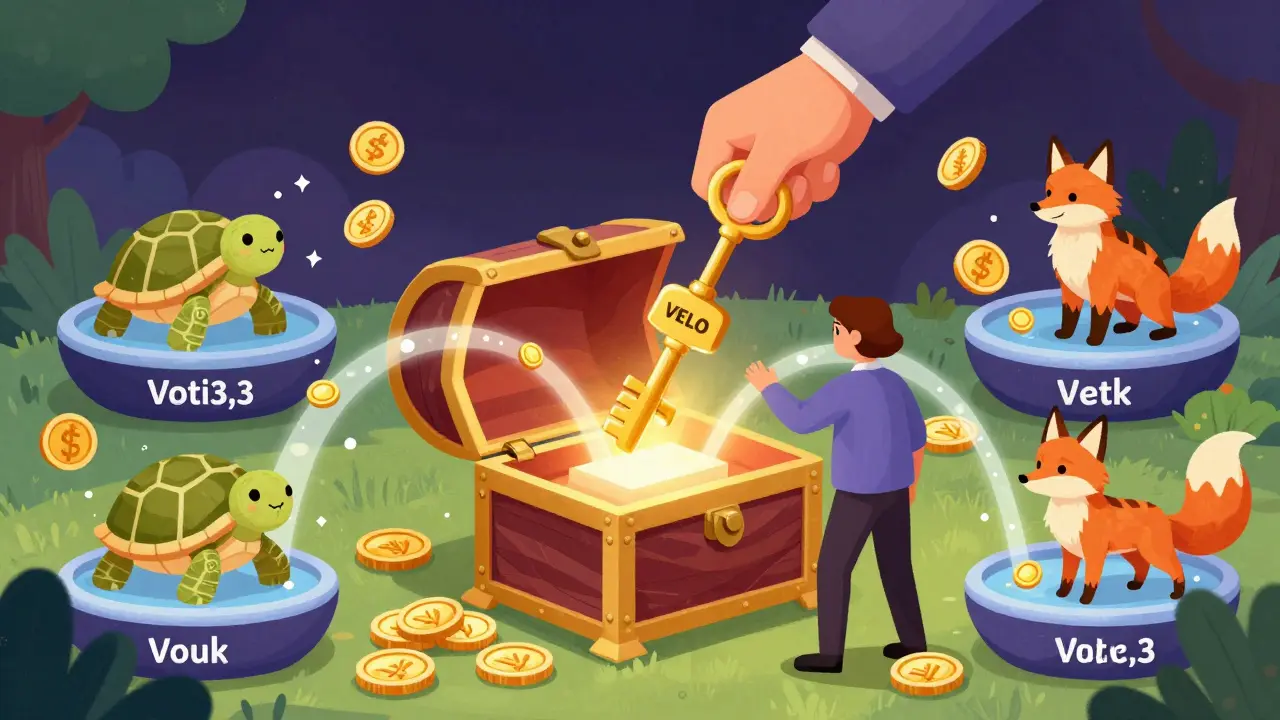
The VELO Token and Governance Model
The heart of Velodrome’s economy is the VELO token. But simply holding VELO doesn’t give you special powers. To unlock the full potential of the protocol, you need to engage with its governance model, known as ve(3,3).
This model requires you to lock your VELO tokens for a specific period, ranging from one week to four years. When you lock your tokens, they convert into veVELO. The longer you commit to locking them, the more veVELO you receive. This voting power allows you to direct "liquidity emissions"-essentially, the new VELO tokens minted by the protocol-to specific pools.
Why does this matter? Because the pools you vote for receive extra rewards. In return, voters receive 100% of the trading fees and bribes generated by those pools. This creates a powerful alignment of incentives. Protocols wanting deeper liquidity will bribe voters to support their pools, and individual users can earn passive income by steering rewards toward high-volume trading pairs. It turns governance into an active revenue stream rather than a dusty forum discussion.
Pros and Cons: Is Velodrome Right for You?
No platform is perfect. Before you bridge your assets, consider the strengths and weaknesses of using Velodrome in the current market landscape.
| Advantages | Disadvantages & Risks |
|---|---|
| Extremely low gas fees (often <$0.10) | Voting mechanism can be manipulated by large stakeholders |
| High liquidity depth on Optimism | Complex governance model has a steep learning curve |
| Innovative fee distribution to voters | Dependent on Optimism network security |
| No venture capital backing (community-owned) | Risk of phishing scams mimicking the brand |
The biggest risk isn’t necessarily technical failure, but human error and social engineering. There have been documented cases of fraudulent websites (such as governance-velo[.]finance) attempting to steal credentials by promising fake rewards. Always verify you are on the official domain, velodrome.finance. Additionally, while the smart contracts are audited, the voting system has theoretical vulnerabilities where large entities could skew incentives away from optimal outcomes for smaller users.

Getting Started: A Practical Guide
If you decide to try Velodrome, the setup process is straightforward if you already hold Ethereum. First, you need ETH on the Optimism network to pay for gas. You can bridge your assets using the official Optimism Bridge or third-party aggregators like Stargate Finance or Bungee Exchange. These tools automate the cross-chain transfer, moving your ETH from Layer 1 to Layer 2 quickly.
Once your wallet (like MetaMask or Rabby) is connected to the Optimism network, navigate to the Velodrome dashboard. From there, you can swap tokens instantly. If you want to earn yields, you’ll need to provide liquidity to a pool. For beginners, sticking to stablecoin pools (like USDC-USDT) offers lower risk due to reduced impermanent loss, while volatile pairs offer higher potential returns but come with greater price fluctuation risks.
Velodrome vs. Competitors
Velodrome doesn’t operate in a vacuum. On Optimism, it competes with other DEXs, though it holds the dominant market share. How does it stack up?
- Uniswap V3: While Uniswap is available on Optimism, Velodrome often offers better liquidity depth for specific local tokens and a more integrated reward system for long-term participants via the ve(3,3) model.
- SushiSwap: Sushi has a broader multi-chain presence, but on Optimism specifically, Velodrome’s native integration and lower fee structures often make it the preferred choice for locals.
The key differentiator remains the incentive structure. Most AMMs rely heavily on volume-based fees. Velodrome supplements this with emission-based rewards directed by governance, making it attractive not just for traders, but for yield farmers looking to maximize returns through strategic voting.
Is Velodrome Finance safe to use?
Velodrome is generally considered safe as it is open-source and has undergone multiple security audits. However, like all DeFi platforms, it carries smart contract risks. Users must also be vigilant against phishing scams, ensuring they only interact with the official velodrome.finance domain.
What is the minimum amount to start trading on Velodrome?
There is no strict minimum deposit for swapping tokens. However, you need enough ETH on the Optimism network to cover gas fees, which are typically fractions of a cent. For providing liquidity, you should aim for amounts large enough to make transaction fees worthwhile relative to your investment.
Can I withdraw my locked VELO tokens early?
No, once you lock VELO tokens to receive veVELO, they are locked for the duration you selected (up to 4 years). You cannot withdraw them early without losing the voting power and associated benefits. Plan your lock-up period carefully based on your long-term commitment to the ecosystem.
How does Velodrome compare to Uniswap on Optimism?
While Uniswap is a global standard, Velodrome is optimized specifically for Optimism. It often provides deeper liquidity for native OP ecosystem tokens and offers a unique governance reward system (ve(3,3)) that allows users to earn additional yields by directing liquidity incentives, a feature Uniswap lacks in the same form.
What are the trading fees on Velodrome?
Velodrome charges a competitive flat fee of 0.04% per trade. Half of this (0.02%) goes to liquidity providers, and the other half (0.02%) goes to veVELO token holders. Gas fees on the Optimism network are separate but typically remain under $0.10 per transaction.